4th year students were debating about the use of uniforms. Are
uniforms more convenient? Are they boring? What would you do if Norba
school decided to make students wear uniforms? Read an article about
this issue and then give your own opinion adding a comment.
The
question of whether children should wear a uniform to school always
makes for a lively debate, and not only among students! In some
countries school uniform is normal and most schools make their students
wear one. Britain is the most obvious example of this, but in many other
countries with strong links to Britain uniform often has to be worn to
school - examples include Australia, Ireland, New Zealand, Singapore,
Hong Kong, South Africa and many other African countries. Uniform is
also required at almost all schools in Japan. In other countries,
particularly in continental Europe, the USA and Canada, uniform is very
rare in state-funded schools, although private schools may have one.
Debates about school uniform have been going on for decades in different
countries and districts, but during the 1990s state schools in the USA
began to adopt uniforms. At first uniform rules were seen as a way of
stopping children dressing in gang colours in troubled urban areas.
Later, claims that introducing uniform leads to better discipline and
educational results encouraged other school districts and schools to
make a change. Both the Clinton and Bush administrations were in
favour of school uniforms. Other countries have picked up on this trend.
whether=if (si)
lively=animado
state-funded school=escuelas públicas
claims=afirmaciones
encouraged=animó
have picked up on this trend=han seguido esta tendencia
LISTENING ACTIVITY 1: FOR AND AGAINST SCHOOL UNIFORMS
1.-Listen without watching:
a.-What two reasons are given to support the use of school uniforms?
b.-What two reasons are given against using school uniforms?
2.-Watch and check.
LISTENING ACTIVITY 2: TEACHERS, STUDENTS AND PARENTS GIVE THEIR OPINION ON SCHOOL UNIFORMS.
1.-Watch and take notes of ideas supporting the use of uniforms and ideas against it.
There's more! What if someone asks you to do something (in a polite way)? For example:
Direct speech: "Close the window, please"
Or: "Could you close the window please?"
Or: "Would you mind closing the window please?"
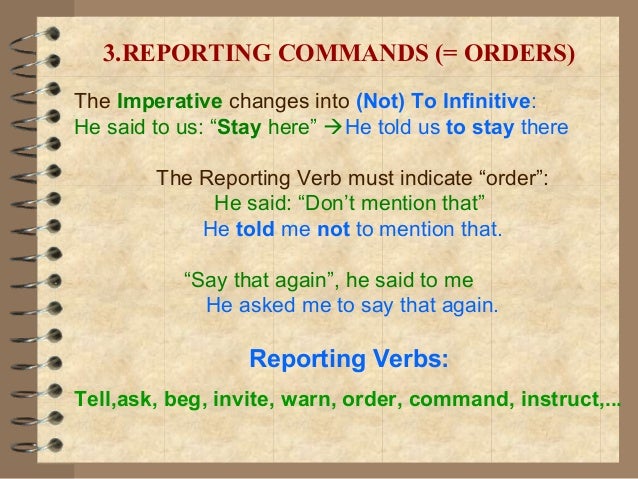
All of these requests mean the same thing, so we don't need to report every word when we tell another person about it. We simply use 'ask me + to + infinitive':
Reported speech: She asked me to close the window.
Here are a few more examples:
Direct Request
Reported Request
“Please help me”.
She asked me to help her.
“Please don't smoke”.
She asked me not to smoke.
“Could you bring my book tonight?”
She asked me to bring her book that night.
“Could you pass the milk, please?”
She asked me to pass the milk.
“Would you mind coming early tomorrow?”
She asked me to come early the next day.
To report a negative request, use 'not':
Direct speech: "Please don't be late."
Reported speech: She asked us not to be late.
Reported Orders
And finally, how about if someone doesn't ask so politely? We can call this an 'order' in English, when someone tells you very directly to do something. For example:
Direct speech: "Sit down!"
In fact, we make this into reported speech in the same way as a request. We just use 'tell' instead of 'ask':